
Anuk Rocha: At The Wunderwall Antwerp
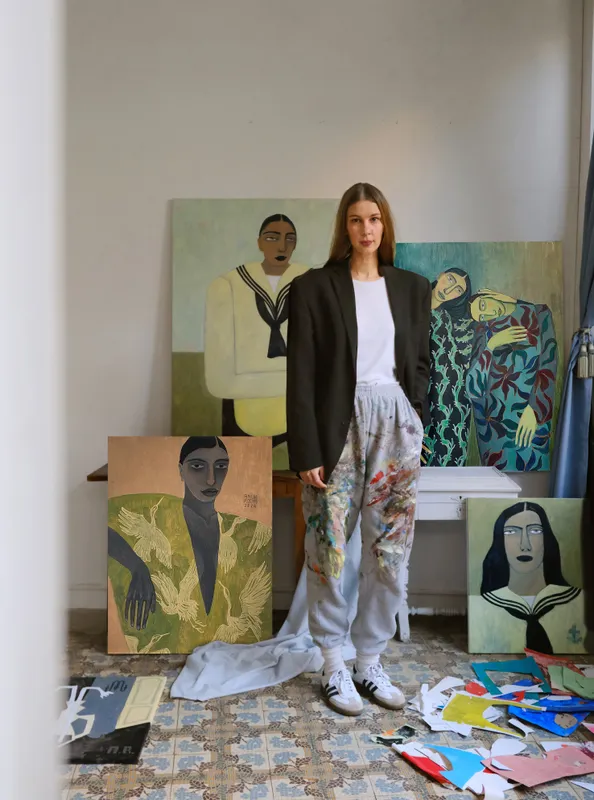
Anuk Rocha is a contemporary painter whose work explores the human experience as a layered, fragmented, and continuously evolving state. Through portraiture, she reflects on interior life, memory, and perception—probing how identity is constructed, concealed, and revealed over time. Her paintings function less as representations of individuals than as psychological and emotional topographies, offering quiet meditations on existence, embodiment, and relational presence.
Born in Germany to Bosnian parents, Rocha’s multicultural background informs a pracice deeply engaged with questions of belonging, visibility, and self-definition. After graduating in fashiondesign from ESMOD Paris and working as a designer for Maison Martin Margiela and Damir Doma, she eventually left the fashionworld to dedicate herself fully to painting. This trajectory continues to shape her visual language: an acute sensitivity to surface, fabric, rhythm, and structure permeates herwork.
Drawing conceptual inspiration from figures such as Pina Bauschand Chantal Akerman, Rocha’s paintings operate through restraint and repetition, allowing subtle gestures, silences, and pauses to become sites of meaning. The figures appear introspective, suspended between inner reflection and outward gaze, inviting the viewer in to a shared contemplative space.
Rocha is known for her patchwork portraits—composite figures assembled from memory rather than direct observation. These faces are not fixed identities but vessels of experience, carrying traces of multiple lives, emotions, and temporalities. Her textured, layered technique mirrors an introspective process of assembling the self: fragments are overlaid, erased, and remerge, suggesting identity as a constructed and continually negotiated condition rather than a fixed state.
Fabrics and patterns in Rocha’s portraits are charged with symbolic meaning, carrying reflections on universal themes such as time and mortality, joy, suffering or the self and existence. Some motifs appear complete, others remain as faint outlines, evoking experiences that have faded, fractured, or never fully materialized. In this way, textile surfaces become emotional archives—informative skins through which the figure navigates time and vulnerability.
